Startups Over Degrees: AI Breaks the Monopoly on Knowledge
U.S. venture capital firm Andreessen Horowitz has launched an AI educational institution to replace traditional universities. In an era where fast execution is more important than knowledge accumulation, the essence of what humans must learn is fundamentally changing.
AI Summary
U.S. venture capital firm Andreessen Horowitz has launched an AI-focused educational program aimed at replacing traditional universities by encouraging students to build products and launch startups immediately. As AI rapidly automates the accumulation and processing of knowledge, industries across the globe—and particularly in Asia's tech hubs like Busan—are shifting to value agile execution and problem-solving over formal academic degrees. This paradigm shift forces humanity to redefine learning, pushing individuals away from rote memorization and toward uniquely human endeavors such as creative leaps and ethical judgments.
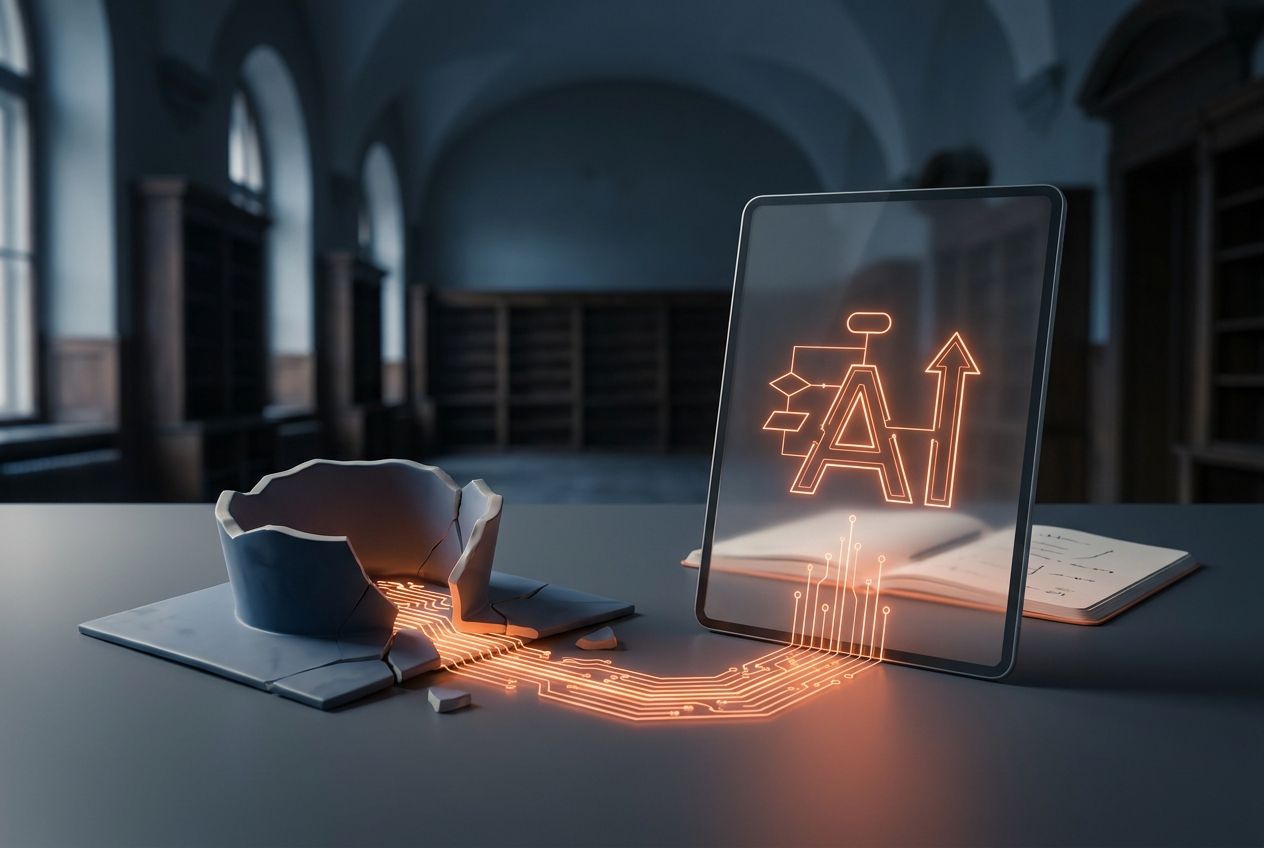
For a long time, humanity considered knowledge a privilege reserved for the few. Medieval monasteries held this role, and modern universities inherited it. The university was a massive melting pot where human intellect was refined to meet societal standards through a set period of academic study. We handed out certificates called degrees to those who went through this arduous process, socially acknowledging their expertise. However, the moment machines took over the accumulation of knowledge and logical computation skills—once believed to be uniquely human—this centuries-old, steadfast belief began to shake at its roots. Machines do not know fatigue, and they can digest a human's lifelong learning capacity in just a few days.
The recent initiative introduced by U.S. venture capital firm Andreessen Horowitz reveals a highly intriguing symptom from a civilizational perspective. They have launched a new artificial intelligence educational institution targeting high school graduates and college dropouts to replace traditional university education. Their goal is clear: to foster untamed talents capable of immediately building AI products and launching their own startups, rather than focusing on blackboard theories. This is not merely a fragmented event where a new type of academy appears in the market. It is a symbolic scene demonstrating that the university's long-standing monopoly on the transmission of knowledge is being actively dismantled by the frontlines of tech capitalism.
From Owning Knowledge to Defining Problems
In the past, the competitiveness of individuals and organizations was determined by how much information they could hold in their heads. The title of expert also represented the power to access scarce information. Now, however, large language models can churn out a fair amount of expert knowledge in mere seconds. In an era where machines skillfully write perfect sentences and complex code, four years spent on a campus is too long to acquire knowledge and too slow to keep up with the pace of technological change. Andreessen Horowitz's experiment does not teach young talents how to memorize past knowledge. Instead, it seeks to awaken their intuition for capturing real-world problems and solving them immediately alongside machines.
This trend will fundamentally transform the landscape of industries and organizations. Companies no longer unconditionally value the past diligence proven by a degree. Instead, they ask what kind of results one can produce utilizing AI amidst the uncertainty of tomorrow. An era has arrived where imagination and execution power, rather than the sheer volume of knowledge, attract capital. Young entrepreneurs are refusing to belong to massive organizations and are instead bringing their own ideas directly to the market with machines as their excellent assistants.
The era of proving one's knowledge through a degree is coming to an end.
This shockwave starting in Silicon Valley poses a profound question to Asia's industrial ecosystem as well. Particularly for innovative companies aiming to connect Asian markets from a base in Busan, an academic pedigree or a flashy resume is no longer a decisive weapon. Even without massive capital or hundreds of research personnel, anyone equipped with sharp insight and AI tools can introduce products capable of striking the global market beyond Asia. Across Asia, a new rule is being established where the speed of execution overpowers traditional credentials.
Asia has traditionally achieved rapid economic growth through diligent learning and standardized education. The training to find a predetermined correct answer faster than anyone else was Asia's greatest asset. However, AI is already surpassing human speed and accuracy in the process of deriving correct answers. What our ecosystem needs now is not the ability to find a given answer. It is the untamed execution power to ask new questions that machines have yet to answer, and to weave new value while clashing directly in the field.
What Will We Learn?
At the juncture where the form of education is changing, we are once again forced to question the meaning of universities. In a world where AI seamlessly writes code and drafts sophisticated business plans on our behalf, what must humans necessarily sit in a classroom to learn? The phenomenon of talented individuals diving into the frontlines of startups instead of pursuing university badges represents a fundamental crisis for institutional education and, simultaneously, the liberation of human intellect. If machines take exclusive charge of knowledge labor and repetitive computations, humans can finally break free from mechanical memorization and learning to focus solely on creative leaps and ethical judgments that only humans can make.
Throughout history, technology has constantly redefined the way humans understand themselves. Artificial intelligence, too, does not remain a simple productivity tool; it asks us what the true meaning of learning and creation is. The era of proving what one knows with a degree is fading. Now, the courage to willingly dive into an unknown, unfamiliar world and create something using machines as tools will prove the unique value of humans. The most important and chilling question of the AI era is not whether machines will become like humans. It is, after willingly handing over even the accumulation of knowledge to machines, what will humans ultimately leave behind as human work?
This article was automatically translated from the Korean original by AI. For the authoritative version, read it in Korean.
한국어 원문 읽기 →