New Attacks, Old Keys
A side door at a bank, a key everyone thought was deleted, a key held by someone else's company. The security incidents of the past month or so did not break down the front door. What AI changed was not the doors, but how fast old keys get found.
AI Summary
Bank breaches, a leaked admin key, hijacked backup tools and an AI-assisted attack on a documentation platform over the past month or so share one pattern: almost no one broke the front door. Attackers walked in with forgotten keys, partner side doors and credentials held by third parties, and AI mainly made finding them faster. With Korea's revised privacy law tying fines to revenue, the bill for convenience may finally start going to the people who built the side doors.
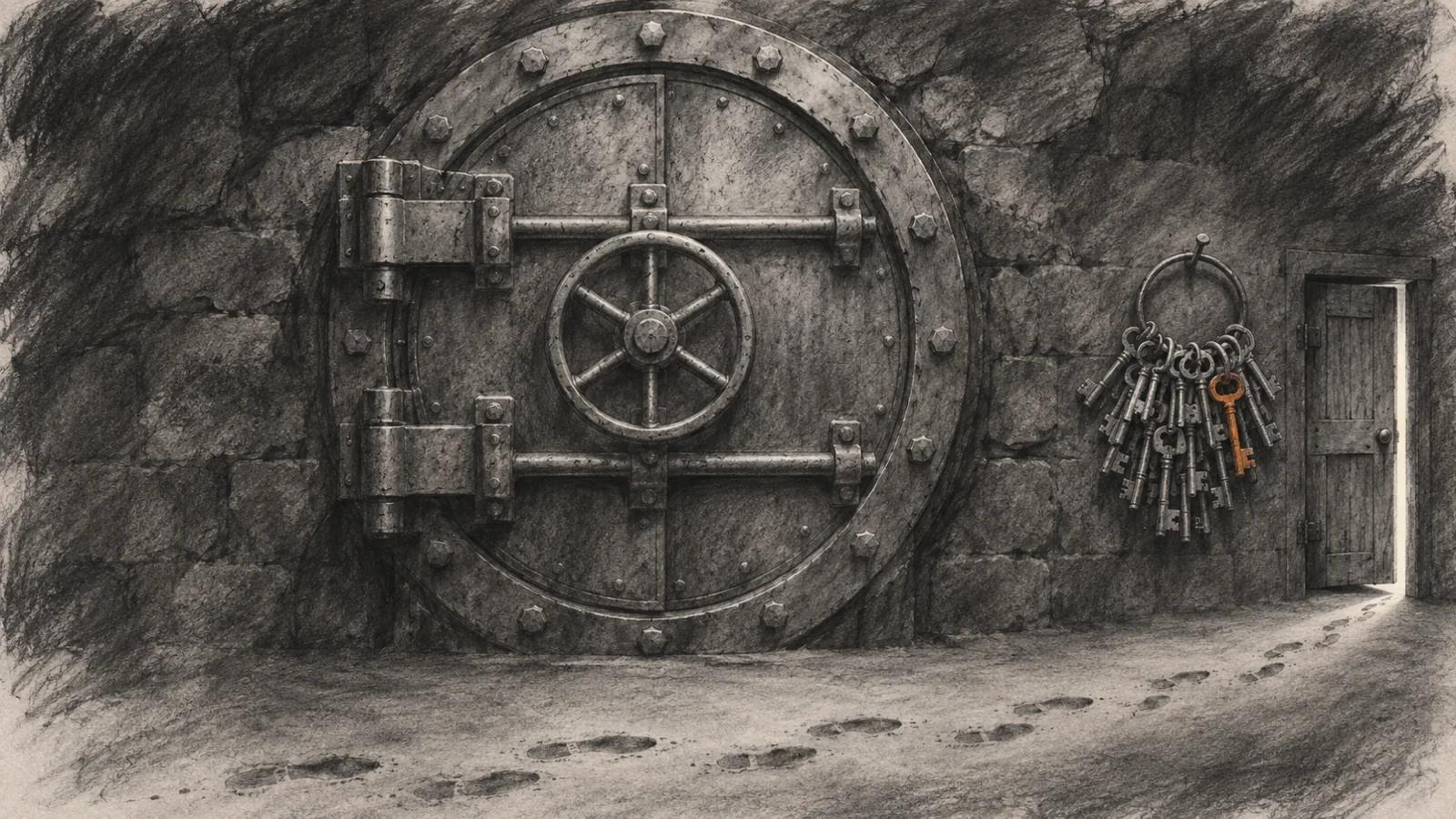
Picture a developer at a twelve-person startup, just before leaving on a Friday night, spotting a mistake. A config file the team shares has an admin key written into it, and it has been pushed to a public repository. She deletes the line, pushes again and closes her laptop. The key is gone from her screen. So she believes the job is done.
The scene is invented, but the plot is not. LiteLLM, an open-source gateway that lets developers call many AI models' APIs from one place, published its account of an incident in October, and it begins almost exactly like this. On May 27, an admin key for an internal agent platform was committed to a config file in a public repository, and about three hours later it was deleted from the file. The follow-up step of revoking the key was not taken before the attack. The key stayed valid for more than four months, sitting in plain view in the commit history.
LiteLLM said the attacker used the key on October 10. Eleven days later, on October 21, a malicious litellm 1.107.0 appeared on PyPI, the Python package repository. By the time the company stopped its distribution, the bad version had been public for about two hours.
The past month or so has given security news no rest. Starting with Shinhan Bank on October 1, banks announced customer data leaks one after another, and the Personal Information Protection Commission (PIPC) fined an education company and a medical foundation. Across the sea, a backup service became the way into customers' Microsoft 365 accounts, and the documentation platform GitBook said it had been hit by an attack that used AI agents. Taken one by one, they look unrelated.
Line them up and the common thread shows. Almost none of these attackers broke down the front door. They opened it with a key someone had left lying somewhere else. There was the key people thought they had deleted, the side door left open for partners, the key another company held on your behalf. AI appears in some of the cases. But what it produced was not a new door. It was speed at finding old keys.
The Front Door Held
The route in the incident Shinhan Bank announced on October 1 was a quick-lookup page for loan brokers. It is a service opened so that brokers can run a simple lookup without a digital certificate. According to CBS NoCut News and others, the breach started at this page and went on to break through other quick-lookup services in turn, and about 25,000 customer records leaked, including 66 resident registration numbers and 97 pieces of connecting information (CI). Materials submitted to the National Assembly, as reported by iNews24, put the number of affected customers at 25,729.
Around the same time, customer data also leaked from KB Kookmin Bank and Hana Bank. At KB Kookmin Bank the route was a mobile work-support system for employees, and both banks said the leaks happened in systems separate from the ones that process financial transactions. On October 4, President Lee Jae-myung ordered a thorough investigation and countermeasures over data leaks at financial and public institutions.
The figures from the National Assembly audit hurt more. According to audit materials reported by iNews24, it took Shinhan Bank 15 hours and 26 minutes to notice the attack, and Hana Bank 41 hours and 44 minutes. On October 19, the chief executives of five banks stood in the hearing room of the National Assembly's National Policy Committee audit.
Look again at where the walls gave way. By the banks' own accounts, the core that handles accounts and transfers held. What fell were the systems attached to it. At Shinhan Bank it was a small door cut beside the front door to make brokers' work easier, and at KB Kookmin Bank it was an app that helps employees do their jobs. The convenience went to the people who cut the door and the people who used it. When personal data walked out through that door, the ones who paid were customers who never knew such a door existed.
Daekyo, which the PIPC fined 3.255 billion won at its October 28 plenary meeting, also had a side-door problem. The PIPC found that unnecessary access was possible from an affiliate's web server to Daekyo's member database, and that the company failed to respond properly even after being notified of a detection by its security monitoring, so the same kind of access and leak happened again. About 650,000 members were affected. At the same meeting, Younghoon Medical Foundation was fined 630 million won because it had no measures to detect and block web-vulnerability attacks and encrypted passwords with a weak method. The number of people affected was 188,481.
Deleted Keys Don't Disappear
The TVING incident belongs to the same lineage. According to the findings the Ministry of Science and ICT announced on September 3, the attacker obtained a developer's access key for the development environment. The findings said TVING developers had left access keys exposed in source code or stored them in plain text, and that TVING had found such vulnerabilities in a 2024 penetration test and never fixed them. The affected accounts numbered 39.54 million, counting duplicates, across 361 projects.
At the October 6 National Assembly audit by the Public Administration and Security Committee, the loss of about 6GB of data from the webmail of the Korea Local Information Research & Development Institute (KLID) came up. Rep. Lee Kwang-hee of the Democratic Party pointed out that a vulnerable program that should have been removed when the email system was built in 2018 was still there. Something left uncleared eight years ago opened a door this year.
Back to LiteLLM's key, where the heart of this lineage shows. Git does not forget. A line deleted from a file stays in the commit history, and the history of a public repository can be downloaded by anyone. LiteLLM's key vanished from the file in three hours, but it remained in the public commit history until October 22.
Deleting and revoking look alike but do different jobs. Deleting a key cleans up your own screen. Only revoking the key and issuing a new one makes a copy someone has already taken useless. The first job ends on the spot. The second means finding every service that used the key and swapping in the new one, which is a hassle. So many teams stop at the first. These incidents show where that stopping point leads.
Many security incidents begin in the other half of a job everyone believed was finished.
A Keyring in Someone Else's House
Sometimes the key hangs in someone else's house altogether. On October 16, the security firm Huntress warned that the Microsoft 365 credentials of ConnectWise Cloud Backup (formerly SkyKick) had been stolen and that the backup app's identity was logging in to customer tenants. As of the 16th, Huntress had confirmed unauthorized logins at 162 tenants. In an update the next day, it said login attempts from the attacker's IP addresses had been seen at nearly 1,000 tenants, and more than 300 of them had succeeded.
What makes this incident frightening is that securing employee accounts alone could not have stopped it. The multi-factor authentication set up on each employee account did not block this route. The one logging in was not an employee but the app to which the company had handed permissions when it entrusted its backups. On the 17th, ConnectWise disabled seven related app identities and halted Cloud Backup. The company said that as of the 18th there were no signs that backup data had been compromised.
That same weekend, TeamUpdraft, maker of the WordPress backup plugin UpdraftPlus, confirmed an intrusion into its own website and announced it on the 19th. The company said it believes the intruder accessed a customer database, and that database held connection keys for UpdraftCentral, its remote management service. The security firm Patchstack said the attacker used these keys to install backdoor plugins on connected sites, and that 99 different plugin names alone were observed.
Two points stand out in Patchstack's analysis. Accounts were linked through a consent checkbox that was checked by default, and the keys had no expiry. A key created in November 2025 still worked in October 2026. TeamUpdraft pushed an update on the night of the 19th that cut the existing connections, but it advised that the update does not remove plugins or admin accounts the attacker had already planted.
On November 2, the documentation platform GitBook was breached. GitBook described the incident as a sophisticated, targeted attack using AI agents. The list it gave of what may have been accessed tells you the nature of the incident: integration tokens, Git sync secrets, API tokens, and the questions visitors to customers' documentation sites had put to the GitBook assistant. GitBook invalidated every customer's API tokens and told customers who use MCP servers to authenticate again. It said payment information and passwords were not compromised and that there was no evidence documentation content had been altered.
In effect, one documentation tool had the keys to repositories and connected services hanging together. Small teams have more of these links. They do not run servers themselves, so they hand backups to one company, documents to another, deployment to a third. Each handoff means giving away one more key. That keyring hangs not in our house but in theirs.
| Where the key was | Why it was dangerous | Known result | |
|---|---|---|---|
| Shinhan Bank | Started at the quick-lookup page for loan brokers | A lookup path that opened with only a phone verification code | Data of 25,729 customers leaked |
| TVING | Development-environment access key | Exposed in source code and stored in plain text; 2024 penetration test findings not fixed | 39.54 million accounts affected (duplicates included) |
| KLID | Webmail system | Vulnerable program that should have been removed in 2018 was left in place (flagged at the National Assembly audit) | About 6GB of data leaked |
| LiteLLM | Commit history of a public repository | Deleted from the file only; key never revoked | Malicious 1.107.0 distributed for about two hours |
| ConnectWise | The backup app's MS 365 credentials | App permissions, unaffected by employees' multi-factor authentication | Unauthorized logins succeeded at 300+ tenants |
| TeamUpdraft | Remote-management connection keys in the customer database | Connections made by default setting; keys with no expiry (Patchstack analysis) | 99 backdoor plugin names observed |
| GitBook | Integration tokens and Git sync secrets | Integration keys gathered in a single documentation tool | API tokens of all customers invalidated |
AI Changed the Speed
How deeply AI was involved in these incidents is not yet fully known. In its post-incident report, GitBook judged that most of the attacker's activity was carried out through automation and AI. In an update on the 27th, Huntress said Microsoft had named Storm-0940 as the actor behind the ConnectWise case and that the group used an open-source multi-agent AI framework.
The document that shows most closely what an AI attack actually looks like is the report the Acronis Threat Research Unit (TRU) published on November 4. The team found an exposed development server belonging to an attacker who was targeting Taiwanese emergency services, and identified 12 AI agents inside it. Nine of them were actually running, and the MCP servers tied to them at one point grew to 13.
The interesting part is the models. According to the report, commercial AI models repeatedly refused the real attack tasks. The attacker ran open models in the DeepSeek, GLM and Qwen families, stripped of their safeguards, on its own GPUs and rented ones. The commercial models' refusals did not stop the attack. They only changed its ingredients.
The more important part is on the victims' side. The emergency patient record platform of the Taipei fire authorities, one of the victim agencies, held electrocardiograms, ambulance video and vital signs, and the report said this data could be reached without logging in. Acronis wrote that the agents did not manage to create access that did not already exist where defenses held. It concluded that hiding things is no longer a valid defense.
Those two sentences are this piece's conclusion as well. AI is not yet a technology for breaking locked doors. What it does is find unlocked doors, keys people thought they had deleted, and side doors nobody remembers, far faster and in far greater numbers than people can. In the past a forgotten door could stay forgotten for years, because no one ever came all the way there to try the handle. Now an agent tries the handles one by one all night.
The speed on the defending side has changed too. Microsoft fixed 1,411 vulnerabilities in its regular October security update. BleepingComputer wrote that it was the largest ever, coming amid Microsoft's push to find and fix vulnerabilities with an AI platform. If finding gets faster on both sides, the part that falls behind is the human hand that actually installs the patch and actually changes the key.
The Bill Changes Address
In Korea, the price of that lagging hand has changed. The revised Personal Information Protection Act, in force since September 11, raised the cap on fines to 10% of revenue. Not every violation qualifies. The cap applies to cases where, through intent or gross negligence, a violation was repeated within three years, or harmed 10 million or more people, or a leak occurred because a corrective order was not followed. Revenue unrelated to the violation is excluded from the calculation. The previous cap was, in principle, 3% of total revenue.
A path to a discount opened alongside it. Companies that invested in security before an incident can get up to 40% off the base amount of the fine. But according to ZDNet Korea, anyone with intent or gross negligence is excluded from this investment reduction. What the provision says is clear. From now on, the bill will depend less on whether an incident happened than on what you did before it.
Recent rulings point the same way. What the PIPC stressed in the Daekyo decision was that the company failed to respond properly even after being notified of a detection by security monitoring. The TVING findings made a point of raising the 2024 penetration test for the same reason. The authorities' question is shifting from whether an incident happened to whether you knew and left it alone.
The bill for convenience has been going to the wrong address. Whoever cut the side door got faster work, and the price was paid by the people whose names and resident registration numbers were stolen. Revenue-linked fines are a device meant to redirect that bill to the party that built the door. Whether the address really changes will be shown by enforcement from here on.
Monday Morning, Count the Keys
A team of ten or so can hardly keep dedicated security staff. Still, it can start by counting the places these incidents point to. Most of this can be started within the week.
Don't be alarmed if the list comes out long. Most companies find the same. The dangerous company is the one with no list. If you don't know how many keys there are, you can't notice when one goes missing.
Back to the developer in the opening scene. What she did on Friday night was not wrong. She did half of it. Revoking a key is a bit more of a hassle than deleting it. The trouble is that the cost saved by skipping that hassle is billed later, and usually to someone else. Attacks will keep getting newer. For now, though, the key that opens the door is most likely to come from the other half of the job we believed we had finished.
So one question remains. When will the party that saved itself the hassle and the party that receives the bill be the same?
This article was automatically translated from the Korean original by AI. For the authoritative version, read it in Korean.
한국어 원문 읽기 →