The Most Expensive Interview Assignment
About $6.34 billion left Binance, the largest theft in crypto history. The decisive entry point was an interview assignment file sent by a fake company. Binance's incident report lets us retrace the intrusion path that began in June.
AI Summary
Binance disclosed in an incident report published on November 3 that about $6.34 billion in assets was drained, the largest theft in crypto history. The decisive entry point was a coding assignment sent by a fake company to a Binance software engineer, part of a multi-stage attack that began in June. The FBI pointed to North Korea on October 31, and Binance said it had frozen or seized about $2.85 billion as of November 3.
In September, a message arrives on a job platform. The sender introduces himself as a project director at a company. The first interview is a video call with an HR representative. As if to build trust, the other side even shows a social media account filled with personal photos and videos. The second interview is held on a messenger with someone described as the CEO. At the end of the conversation, an assignment is handed over: download a code repository onto your work computer.
The company did not exist. The person who received the assignment was a Binance software engineer. This is the scene described in the incident report Binance published on November 3. That assignment file became the decisive entry point in the incident in which about $6.34 billion in assets left the exchange. It is the largest theft in crypto history.
The code in the assignment ran during installation and swapped a legitimate component of a development tool for a malicious version. Binance acknowledged that its endpoint security tools at the time failed to catch this zero-day malware. The attacker used obfuscation and detection-evasion techniques, and also worked to erase traces.
The attacker was in no hurry. On October 20, using the infected computer and an internal AI tool, the attacker took over the accounts of two other engineers. One of them was a DevOps engineer in charge of wallet operations, and his computer held a container-deployment permission token. The report does not detail how the internal AI tool was used. Binance said only that it had rebuilt the tool and its access controls.
The execution date was October 29. Using the computer of the other engineer, whom the attacker had taken over on October 20, the attacker deployed containers with the stolen permissions and ran a malicious script. Starting at 8:05 p.m. UTC, XRP drained out of five hot wallets, followed by Solana, Optimism, 18,270 bitcoin and Ethereum. Blockchain analytics firm TRM Labs estimated that most of the assets left Binance wallets across 10 blockchains in about 20 minutes.
Binance's wallets use multi-party computation (MPC), so stealing a single key does not open them. Instead of stealing a key, the attacker used employees' legitimate permissions to operate internal systems and obtain signatures. The Ethereum execution-rights delegation (EIP-7702) approvals obtained this way kept working even after Binance halted deposits and withdrawals. Binance explained that, because of the MPC structure, there was no single key to revoke. The delegation code planted in the hot wallets was removed only at 00:10 UTC on the 30th.
In a year when Binance blocked 57 suspected North Korea-linked cases, a single interview assignment opened the door to a chain of intrusions.
The U.S. Federal Bureau of Investigation (FBI) pointed to North Korea on October 31. According to BleepingComputer and The Register, the group the FBI named is TraderTraitor, a hacking group commonly lumped in with the Lazarus Group. The FBI had also named this group as the force behind the $1.5 billion theft from Bybit in February 2025. This time the scale is more than four times larger. Binance said it detected and blocked 57 cyber threats suspected of North Korean links this year alone, including fake job interviews.
Some of the money is coming back. Binance said that as of November 3 it had frozen or seized about $2.85 billion. Stablecoin issuers such as Tether and Circle have also moved to freeze funds. Deposits and withdrawals were halted on the 29th, and withdrawals were reopened in stages over the weekend, starting with bitcoin. Binance said the company, not its users, will bear the loss. It is filling the gap with the Secure Asset Fund for Users (SAFU), part of its futures insurance fund and company funds. On October 31 it announced it had covered up to 90%, and the November 3 report said it had replenished 98% of the affected token assets as of October 31.
The explanation has also changed. Binance first said it appeared that the laptop of a single DevOps engineer had been breached. The November 3 report described a multi-stage attack running back to June. In June, a wallet DevOps engineer, trying to install an AI coding tool he found through a search, downloaded a tampered Homebrew installer. At that time the security team caught it, replaced the device and rotated the credentials. In the report, Binance apologized, saying it should not have happened, and stressed that this was not a single breach or simple phishing.
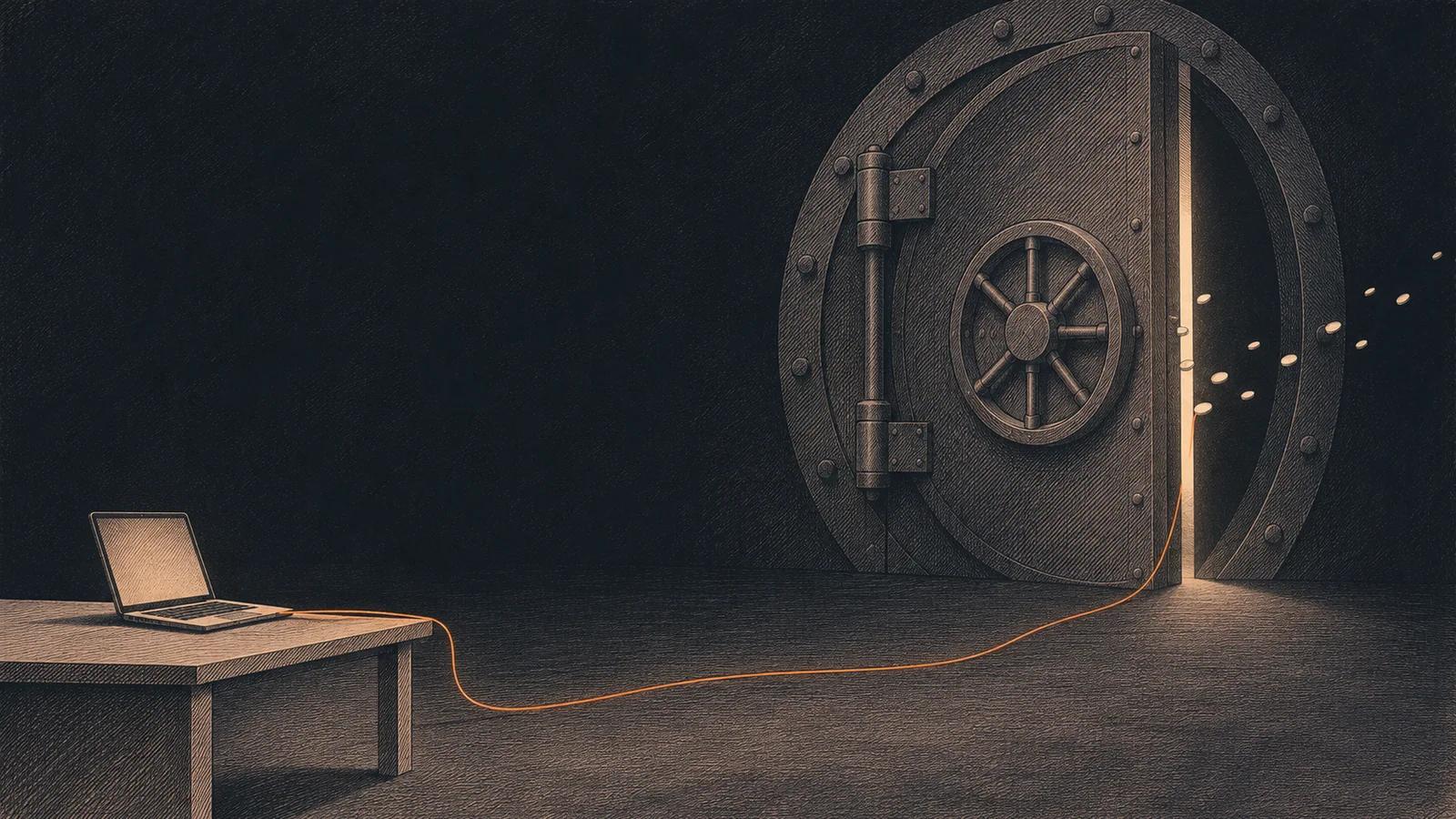
The lesson of this incident lies outside the wallets. The attacker did not break the key-management system head-on. The attacker went around it, through the people with the authority to operate it. An installer found through search, an assignment from a job interview and an internal AI tool used by employees became the entry points in turn. A single developer laptop can be the road to an exchange's vault. That is the conclusion Binance paid $6.3 billion to reach.
This article was automatically translated from the Korean original by AI. For the authoritative version, read it in Korean.
한국어 원문 읽기 →