with Ariel Manzur, co-founder of Godot Engine
I met Ariel Manzur, co-founder of the open-source game engine Godot, at Busan Indie Connect 2026. I asked what the open-source project leader thinks amidst the AI wave, and his answer made me reflect on the attitude I should adopt.
AI Summary
At Busan Indie Connect 2026, the author interviewed Ariel Manzur, co-founder of the open-source game engine Godot, discussing the engine's stance on the rapidly evolving AI landscape. Manzur explained that while Godot's text-based formats make it highly compatible with AI tools running outside the engine, the Godot Foundation deliberately avoids integrating AI into its core scope to maintain independence and manage resources responsibly. Inspired by Manzur's steadfast and pragmatic approach, the author reflected on their own role as an 'enabler' in building SouthBridge, emphasizing the importance of fostering a sustainable, community-driven AI ecosystem in Busan.
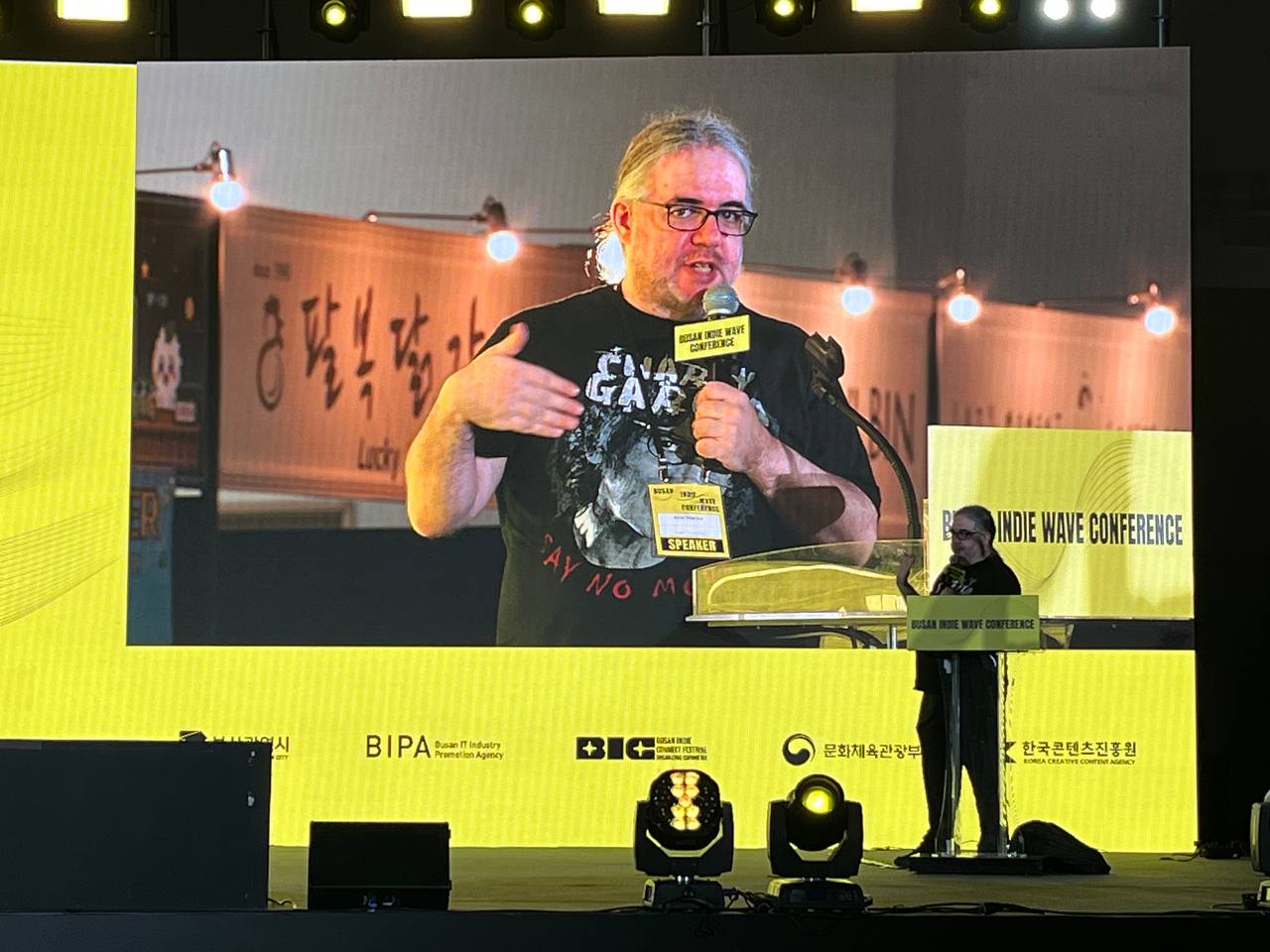
I met Ariel Manzur at Busan Indie Connect 2026.
I attended the session by Ariel, co-founder of the open-source game engine Godot, during the BIC conference.
It was a precious connection during his first-ever trip to Asia, which took two nearly 10-hour flights including layovers from Argentina. I introduced SouthBridge and asked him a few questions.
What does the leader of an open-source project used by countless developers worldwide think about this rapidly changing AI wave? I simply couldn't resist asking.
(After all, this is Busan Indie Connect, and we are SouthBridge, a Busan-based AI community... We always appreciate your full interest and support. 🙇)
1. Calling myself an AI enabler
'I am Heejin. I am building and running an AI community called SouthBridge, based in Busan. I act as a sort of enabler(?)—connecting people and technology, from students and small businesses to big tech and funds, helping everyone do what they want to do.
I am a planner, not a developer, but we live in an era where even I can contribute to open source. AI is bringing massive changes, starting with the sheer impact of the word itself. Particularly in open source, which gathers the open mindsets of diverse people to devise better projects, I see AI acting as a sort of project amplifier and communication tool. I am curious how Godot is facing this trend.'
2. Ariel was remarkably well-spoken.
'That is a good question. Currently, AI in Godot is mostly utilized in a form that runs "outside" the engine. The interesting part is that Godot's scene and resource formats are text-based. This makes it very easy for LLMs to generate or modify scenes.
AI models have probably used the scene files of numerous Godot projects publicly available on GitHub as training data. Perhaps that is why these models write scenes and related code surprisingly well. I have even seen an AI agent run Godot in headless mode to verify that the code runs properly without errors.
Honestly, until just last year, the performance of AI models was not at this level, but the advancements over the past few months have been truly impressive.
Of course, I am aware that there are various controversies surrounding AI. Currently, the Godot Foundation does not include AI-related features in its core scope. There are a few practical reasons for this. For example, there is the issue of who will run the inference and with what resources, as well as the Foundation's principle of not wanting to be dependent on any specific AI company's technology. The Foundation should not appear to be working for a particular company.
Therefore, I am satisfied with the current setup where AI connects outside the engine in everyone's own way. Personally, I prefer using OpenClaw connected to OpenRouter.
Recently, I found an app from a European studio interesting; when you select one of several AI backends, including Claude, it injects all the necessary tech stacks into the context according to the model and connects it with the game engine.
Honestly, even we do not yet know how this technology will evolve in the future. All of this is likely part of a process of countless experiments.'
As always, I told Ariel to feel free to contact me if he had any questions about Busan or Korea, or if he wanted to know about good restaurants. I told him he should 'try Gukbap' (pork soup with rice). I said it was delicious and that I would invite him to Busan next time. (Since he mentioned he'll be staying here for a bit, it would be great if he could have a hot and hearty bowl of Gukbap when the weather is cool. I should leave a link to Halmae Gukbap in the comments.)
3. 'We don’t know how this thing is gonna go' was a fact.
There were no claims like, 'Our project will become like this because of AI.' It can be seen that I simply heard an answer spoken from the perspective of his own project. It means accepting the present, where numerous experiments are taking place, exactly as it is. It is closer to 'awareness' and 'acknowledgment.'
It struck me that this was exactly the most important attitude I, as the main driver, should have when I declared, 'Let's build a community in Busan that drives global-scale inbound and outbound AI initiatives together.'
He may have seemed like a mild-mannered Ariel visiting Asia for the first time, but he was serious and decisive. I thought to myself, 'This is exactly it.'
Regardless of the topic, whether it's AI or anything else, I simply disliked the clickbait remarks and the 'sellers' of small-business lectures and consulting who were eager to play the expert and line their pockets. Yet, on the other hand, seeing people get sucked into such remarks made me wonder if that was just how the market works. Even though the market will change again before long.
There is always a steadfastness in those who lead open source. They are clear and consistent about which path to take. Rather than pretending to know the answers, they explain obvious facts simply and plainly. They say, 'Let's explore and experiment together. Please contribute to that flow. You can support it in your own way.' I felt this is the true pride of open source.
So, what is it that I want to do? -> Instead of just criticizing others, what matters in the end is how you present and prove the sustainability of 'let's do something!' initiatives over time. And to achieve that, you need the courage to confidently bring up any proposal and make it happen.
(Passing through the first half of the year when every day was boiling over with AI hype, the 'sellers' have somewhat died down after just half a year. - It leaves a somewhat bitter taste seeing people who were so busy trying to sell, despite knowing full well this would happen, now pretending otherwise.)
Anyway, the 'initial commit' with Godot's Ariel was quite great. The concise insights I always gain from conversations continuously influence my direction and attitude.
While building SouthBridge, I always discuss and listen to various people about our introductions and the direction we should take. Today, I thought, 'Ah, I need to take on the role of connecting people through technology, mutually creating and helping with what is needed in the process, and finding the path to achieve our goals by taking on challenges together.'
This article was automatically translated from the Korean original by AI. For the authoritative version, read it in Korean.
한국어 원문 읽기 →